
New timelapse video shows history in the making for St Helens town centre
A new timelapse video has been released which captures a year's worth of footage of the dramatic transformation of St Helens town centre in just a few minutes.
Article date: 6 March 2026
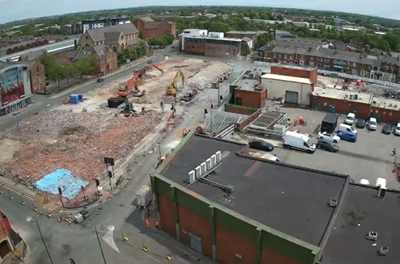
A camera was positioned on Century House, the tallest office building in St Helens town centre, with an unobstructed vantage point overlooking the Phase 1 town centre regeneration programme site in February 2025. It has subsequently recorded all of the key milestones in the project so far.
The timelapse video begins with the complex, phased demolition of the Hardshaw shopping centre and the removal of the old Bus Station.
They are being replaced by Phase 1 development that includes a new St Helens Transport Interchange. The Interchange will contain two fully enclosed, temperature-controlled concourses with solar panels to reduce energy consumption, plus cycling facilities and feature spacious waiting areas, a new Travel Centre, and accessible toilets - including a Changing Places facility. The wider Phase 1 development includes a stunning new Market Hall, a 120-bedroom Hampton by Hilton hotel, 56 apartments, eight townhouses, and 4,266 sq ft of new modern retail space will also be created, all set within extensive new public realm.
The projects form the centrepieces of the town centre regeneration programme being brought forward by St Helens Borough Council and ECF - a partnership between Homes England, Muse and L&G.
The timelapse shows both sites being cleared and the significant efforts made to minimise any waste going to landfill. Masonry leftover from the demolition is shown being carefully sorted so that it could be recycled and reused as part of the foundations for the new buildings.
The footage also highlights that glass from the demolished buildings was removed separately and sent off-site for recycling. Some 7.34 tonnes of glass, roughly the same as the annual glass recycling of 150 average households. Instead of going to landfill, the glass has been melted down and used to create new float glass, a process that saved 5.13 tonnes of CO₂e emissions, along with 8.8 tonnes of virgin raw materials.
Following the clearing of the sites, the video captures the enabling works to prepare both sites for development. As St Helens used to be a centre for mining coal, the area required significant ground improvement. Grouting rigs were used to fill any historic underground seams, then specialist Vibro piling equipment was used to install compacted stone columns deep into the soil using controlled vibration. This process increases the soil's load-bearing capacity and stability to create stronger foundations for constructing new buildings.
Councillor Richard McCauley, Cabinet Member for Regeneration at St Helens Borough Council, said: "This timelapse video is a powerful reminder of a changeover period in the history of our town centre. While much of this work has happened behind hoardings for safety reasons, this video pulls back the curtain on what's been happening so residents can see the sheer scale of the progress made so far. It shows that our vision for a vibrant, sustainable town centre is rapidly becoming a reality, and I hope it gives the community real confidence in the bright future we are building here."
Matt Whiteley, Senior Development Manager for ECF, commented: "When the scale of change happening in a town is this big, it'd be such a shame not to keep a record of what St Helens looked like before the regeneration project, during it, and afterwards, so the community can all see the incredible transformation. I think it's also important that those who've backed this project, whether by securing funding or giving it their personal support, can see what a huge difference it's already making after just a year."
Cllr Steve Foulkes, chair of the Transport Committee at the Liverpool City Region Combined Authority said: "Seeing a year's worth of work condensed into a few minutes really brings home the incredible transformation taking place in St Helens. It's fantastic to see how the Combined Authority's investment is being used to build a more connected town centre that is fit for the future and that the whole community can be proud of."
The film concludes with the installation of underground tanks which are part of a system to capture excess water and reduce the risk of flooding in the town centre, along with the arrival of the first batches of low-carbon steelwork for the new St Helens Transport Interchange. The special steel columns are made of a metal alloy which is often referred to as 'green steel' because the process to create it typically has 60-75% lower carbon emissions than traditional blast furnace steel. It is created by converting recycled scrap metal into construction-grade material.
The St Helens town centre regeneration programme is being delivered with funding from the Liverpool City Region Combined Authority via the City Region Sustainable Transport Settlement (CRSTS),the Government's Towns Fund, St Helens Borough Council, ECF and One Public Estate Brownfield Land Release Fund.